klaryn.ai HubSpot RevOps
HubSpot discovery interview underway with notes and a laptop
HubSpot DiscoveryFree, no credit card

A senior-level HubSpot
discovery interview,
run by AI

Most HubSpot projects fail in discovery — the wrong questions get asked, vague answers get accepted, and the HubSpot architecture inherits every gap. klaryn.ai runs the HubSpot interview the way a senior RevOps architect would: one question at a time, and no answer accepted at face value.

Ironwood Field Services · example discovery
Ironwood Field Services · example discovery — stack, source of truth, then operations. Insights and marketplace sit beside the chat; on a phone, tap the info icons. Synthetic example, same product as a live engagement.
Why HubSpot discovery exists

Not a form.
A HubSpot interrogation —
the friendly kind.

Around 40–60 exchanges, each one building on the last. The HubSpot interview never dumps a questionnaire on you, and it never lets a vague answer slide.

Pace
QuestionnaireConversation

One question at a time

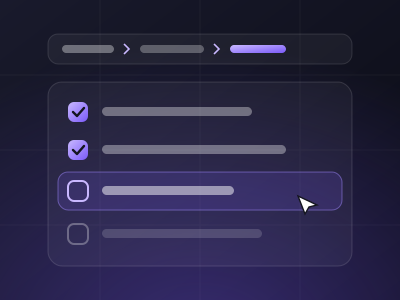
Every turn opens with “what I understood” — a running read-back of your business — then asks exactly one next question. Multiple-choice when the answer has discrete choices, so most turns are one click.

  • Read-back, then one ask
  • Click when the answer is discrete
  • Never a dumped form
Interrogation
Vague inPrecise out

Vague in, precise out

Say “we use spreadsheets for deals” and the follow-up asks which columns, who updates them, and what breaks. That depth is the difference between a generic CRM template and a HubSpot architecture that fits.

  • Follow-ups until it is specific
  • No answer taken at face value
  • Architecture from your real process
Grounding
Last year’s memoryToday’s docs

Grounded in today’s docs

The interviewer checks tier gates, feature limits and product release notes against a full index of the HubSpot documentation while you talk — so what it recommends is what HubSpot actually ships today.

  • Live documentation lookups
  • Tier gates from the index
  • Release notes, not memory
Insights
Waiting roomLive gains

Gains as you answer

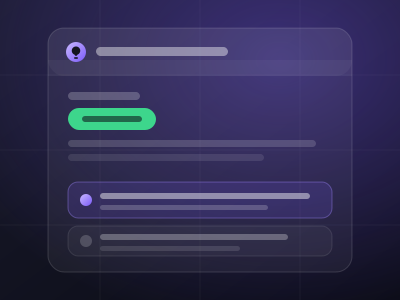
As soon as a concrete advantage appears — time saved, a leak closed, a manual step removed — it lands behind the insights icon. Tap it to open. Fit is honest: Strong, Solid, Partial, or Not yet clear.

  • Gains tied to what you just said
  • Honest fit, not a sales pitch
  • Feeds your free ICP
Open items
Silent gapsParked & returned

Park it, don’t lose it

I don’t have this information parks the question and moves on. Before the ICP, every parked item comes back — answer now, or finish later. The workspace keeps an N open badge so nothing is lost.

  • Skip without stalling the hour
  • Parked items return at wrap-up
  • Assumptions labelled, never guessed
Output
TranscriptFree ICP

A document, not a dump

Discovery ends with a 14-section Ideal Customer Profile, written from what you actually said. Yours free, whatever you decide next — the strategic foundation the HubSpot blueprint is built on.

  • Fixed 14-section structure
  • Yours even if you never buy
  • Green / Yellow / Red, not a wishlist
Before we beginTwo minutes

The interview does not start cold

Every HubSpot discovery opens with a short intake — who this is for, how technical to be, which HubSpot price list to quote, how many people will sit in the portal, how much AI you actually want, and the monthly budget the licensing plan has to fit.

Set the numbers yourself, answer a few sizing questions, or leave it to the interviewer. What you pick is written into the session, so the chat, the ICP, the blueprint and the runbook all follow it.

  • Three steps: about you, business & requirements, then privacy
  • Tone, language and audience stay consistent in every document
  • Sensitive figures stay optional — real numbers or a labelled example
Start with intake
Who

Your business, or a client's

Own company, or an agency running discovery for a customer. The interviewer addresses “your business” or “your client's business” from the first question, and never asks whose it is again.

Tone & language

Plain English, or peer-to-peer

Complete beginner, used HubSpot before, or RevOps pro — jargon density follows you. Pick the language once: the interview, ICP, blueprint and runbook are all produced in it.

Price list

The HubSpot list that actually applies

Country sets the regional price list — standard global, or HubSpot's new seats-and-credits packaging. An existing portal takes the new list off the table; nothing is quoted against the wrong card.

Users & seats

Who will actually log in

Headcount, then seats: core for everyone in HubSpot day-to-day, plus sales, service or Front Office where the edition allows. The licensing plan is built from real roles, not a round number.

Budget & volume

A ceiling the plan has to fit

Monthly HubSpot budget, marketing contacts, email volume, CRM records. Known figures go in now; otherwise a few ranges, or “you decide” — and the first-year TCO is designed inside that appetite.

AI usage

None, a little, or agents across teams

Breeze credits are metered. Say none-to-start, light assistants, a couple of agents, or heavy across sales, service and content — so the plan does not prescribe AI the budget and readiness cannot support.

During the interviewLive, as you answer

The HubSpot interview works while you talk

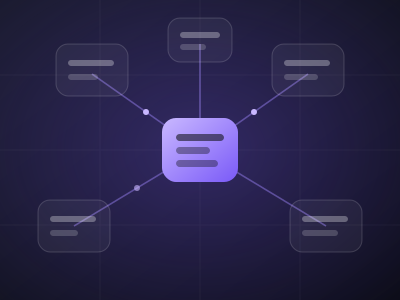
You are not filling a form in the dark. As you answer, the session researches your stack, notes where HubSpot would actually help, and lets you skip or sample anything you would rather not share yet.

Live HubSpot discovery insights accumulating as you answer
Insights

What you're gaining

A live panel accumulates concrete advantages for this business, plus an honest HubSpot-fit read. Not a scorecard of the interview — the value of the hour, surfaced as it emerges.

Live HubSpot Marketplace lookup for named tools
Marketplace

Tools looked up live

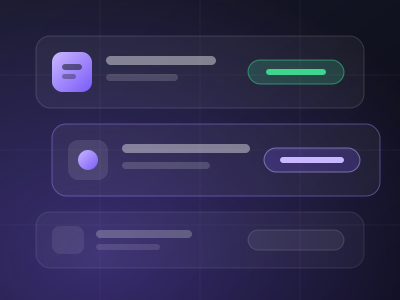
Name a tool and it is researched against the HubSpot Marketplace. Cards show Native, Data Sync, Middleware or Custom, certified status, and a marketplace link — so the architecture is grounded in what actually exists.

Optional example figures for sensitive HubSpot discovery answers
Sensitive figures

Use an example figure

Revenue, margins, volumes, pricing and salaries are optional. Use an example figure and the interview substitutes a labelled sample you can replace after download. The rest of the interview is still about your real business.

Skip and park a HubSpot discovery question as an open item
Open items

Skip and continue

I don't have this information parks the question and moves on. Parked items come back before the ICP — answer them now, or finish discovery later. The workspace keeps an "N open" badge so nothing is lost.

What you're gainingLive as you answer

Insights, not a waiting room

Most discovery interviews extract. This one also returns. As soon as a concrete advantage appears — time saved, a leak closed, a manual step removed — it lands behind the insights icon, tied to what you just said.

Fit is honest, not a sales pitch: Strong, Solid, Partial, or Not yet clear. Everything behind that icon feeds your free ICP.

  • Gains accumulate across the session — never generic "HubSpot is powerful"
  • The fit badge updates whenever the read actually changes
  • Insights sit behind an icon, so the conversation stays one question at a time
OpeningThree ways in

Start the way you want

After intake, the first turn is a choice, not a questionnaire. Talk, share what you already have, or let the interviewer read your public site first.

Start HubSpot discovery by answering in plain language
Talk through it

Answer in plain language

One question at a time, with multiple-choice when the answer has discrete choices. No HubSpot knowledge required — the interview asks about your business.

Upload existing files to brief HubSpot discovery
Share files

Upload what you already have

PDF, CSV, TXT or MD — process notes, CRM exports, an existing ICP. The interview maps each file to the phases it informs, confirms before using it, and skips the opening menu.

Paste a URL so HubSpot discovery can research the company
Research my company

Paste a URL

The interviewer reads the public site once, then pressure-tests what it found with you. It is briefing, not assumed fact — you still confirm what is true.

The flowWhole business first, architecture second

What the HubSpot interview covers

The order matters: the interview earns the right to ask HubSpot-technical questions by understanding your business first. Architecture questions asked cold produce generic answers — the same questions asked after the ICP produce your HubSpot architecture.

Progress is tracked live in a sidebar, phase by phase, and you can pause and resume any time — the session checkpoints itself.

Start free
    • Each product and service line — not a slogan
    • Headcount, revenue band and growth trajectory
    • Legal structure, brands and geography
    • Existing HubSpot portal — or a fresh start
    • The trigger: why this implementation now
    • Green / Yellow / Red account tiers
    • Buying triggers and the emotional blocker
    • Churn pattern and explicit exclusions
    • 12-month goals and the revenue bottleneck
    • Org map, CRM owner and executive sponsor
    • Industry segment, volumes and lead capture
    • Objects, properties and associations
    • Source of truth per data domain
    • Current-state process, step by step
    • Spreadsheet workarounds and stalled deals
    • Lifecycle entry and exit criteria
    • Pipeline stages, gates and handoffs
    • Named tools, researched live
    • Compliance, RBAC and role-based views
    • Service model, SLAs and dashboards
    • AI readiness, L0 through L3
    • Agents in scope — and explicitly out
    • Knowledge content for the customer agent
    • Credit governance and run limits
    • Human-in-the-loop and training toggles
    • Hub and tier mix you actually need
    • Seat types matched to real roles
    • Add-ons that apply — and those that don't
    • Year-one cost, not a list price
    • What can wait until a later phase
    • Parked questions come back, one by one
    • Answer now, or finish discovery later
    • Unresolved items labelled as assumptions
    • A 14-section Ideal Customer Profile
    • A discovery summary of every pillar
No silent gapsThe open-items gate

"I don't know" never disappears quietly

When you can't answer something, tap I don't have this information. The interview parks it as an open item and moves on — a missing volume figure or a legacy system detail never stalls the hour.

Before your ICP is written, every parked item comes back. Answer them now, one at a time, or Finish discovery later. The workspace shows an N open badge and a resume path so you can pick the thread back up. Unresolved items are carried into the blueprint as clearly-labelled assumptions, never silent guesses.

The outputYours free, whatever you decide next

A 14-section Ideal Customer Profile

HubSpot discovery ends with a document, not a transcript. The structure is fixed — no section is dropped because an answer was thin. Every section is written from what you actually said, and it is the strategic foundation the HubSpot blueprint is built on: Green/Yellow/Red → scoring, buying triggers → lifecycle, exclusions → suppression. Useful on its own even if you never buy anything.

Who they are
1

ICP Summary

An archetype label your team can remember, and a single sentence that states who the ideal customer is, what triggers them, and why they are a great fit. This is the line a CEO, a new hire, and a HubSpot scoring rule can all share.

Feeds blueprint §0 Engagement Context · §1 Executive Summary
2

ICP Narrative

One paragraph in the customer's voice — who they are, what they are trying to accomplish, why they need this now, and what makes them a great fit. Written in their language, not product-marketing language, so HubSpot nurture copy and Breeze context start from how they actually talk.

Feeds blueprint §7 nurture messaging · §20 Breeze context seeded from this engagement

3

Company Profile

A firmographic table: industry and vertical, employee count, revenue range, geography, tech stack, budget range, and business stage. These are attributes a salesperson can verify before a conversation — not budget or urgency, which only surface mid-call. They set the data-model anchor (company-centric vs contact-centric) and the geography that drives HubSpot routing, localisation and compliance.

Feeds blueprint §3 Data Model · §2 licensing geography · §9 Integrations starting point

Why they buy
4

Pain Points & Buying Triggers

The primary pains in their words, the events that make them start looking, and the emotional blocker — the underlying fear that makes them hesitate. Buying triggers become HubSpot lifecycle entry criteria; the emotional blocker becomes the nurture sequence that actually lands, instead of a generic drip.

Feeds blueprint §5 Lifecycle entry criteria · §7 nurture automation

5

Behavioral Profile

How they research, who sits on the buying committee (titles, roles, vetoes), how they measure success, the minimum involvement required to succeed, and the content lane they actually trust. Decision-committee structure drives HubSpot association labels and contact roles; the content lane drives forms, subscription types and what you gate.

Feeds blueprint §3 associations and contact roles · §8 Marketing Assets

6

Value Drivers

The three outcomes they will pay for — ranked, specific, and rooted in product success rather than who was easiest to close. These become the six-month success criteria the HubSpot blueprint has to trace back to, so the architecture is measured against what this customer actually values.

Feeds blueprint §1 six-month success criteria · §11 reporting that proves them

7

Buyer Intent Signals

A table of observable signals, what each one means, and the recommended action. Growing headcount, a churned anchor customer, a renewal season they cannot report on — each signal maps to a HubSpot engagement score, a saved view, or a sales play, so the team does not treat every form fill as equal.

Feeds blueprint §4 Engagement scoring · sales View-Gate saved views

Who to pursue — and who not to
8

Green / Yellow / Red Classification

Accounts classified by firmographic fit a salesperson can verify in the first five minutes. Green is who you built this for — proactive outbound, all channels. Yellow is where you experiment — engage inbound, do not pursue cold. Red means do not sell to them, even at an attractive deal size. An ICP without a Red tier is a wishlist; this one is explicit. Fit scoring in HubSpot is graded from Green-tier attributes, not a generic "filled in a form."

Feeds blueprint §4 Fit scoring and MQL threshold · routing priority

9

Exclusion Criteria

Who is out, named, plus the churn pattern to watch — the most common reason a good-looking prospect does not work out. Rooted in highest-LTV customers, not fastest-closing ones. Exclusions become HubSpot disqualification properties and suppression lists; the churn pattern becomes negative scoring and the service design that stops the leak repeating.

Feeds blueprint §4 negative scores · §8 suppression lists · §6 service / CS pipeline

10

Competitive Landscape

Who else they consider, who those alternatives actually serve, and why this ICP prefers you. Written as a positioning table, not a feature dump — so sales knows when to lean in, when to walk, and which objection is really a Red-tier mismatch dressed up as "we're looking at X."

Feeds sales enablement and outbound messaging; not a HubSpot object on its own

How you use it — and keep it honest
11

Data & Research Inputs

What actually informed this ICP, with facts you stated kept separate from what was inferred. Every inferred field is listed — never silently merged into client-stated facts. Recommended next steps name the gaps that still need a customer interview or a source-system check before they become HubSpot baselines.

Feeds labelled assumptions in the HubSpot blueprint — never silent guesses

12

Activation Recommendations

What Marketing, Sales and Customer Success each do with this document on Monday. Targeting, messaging and content tied to the emotional trigger and content lane. Outbound prioritisation, Green/Yellow/Red disqualification, and intent-signal responses. Onboarding triage by tier, expansion triggers, and churn prevention tied to the named churn pattern — so the ICP is an operating system, not a slide.

Feeds blueprint §7 workflows · §16 enablement · how each team uses HubSpot day one

13

Validation Schedule

A named owner, method and cadence for keeping the ICP honest: quarterly review with sales and CS, bi-annual customer survey, annual LTV cohort re-analysis. Any figure you chose not to disclose is listed under sample data used — labelled as a placeholder to replace after download, never treated as a real baseline. Unresolved discovery items land here as things to confirm, with a source, not as invented numbers.

Feeds blueprint §18 post-launch milestones · sample figures stay labelled, never silently adopted

14

ICP Version & Owner

Version, date, named owner, and next review date. Someone on your team owns this document after the interview ends — so the profile that drives HubSpot scoring and routing has a human responsible for the next quarterly check, not a file that goes stale in a folder.

Feeds blueprint §14 RACI — who owns the ICP after go-live

Ironwood Field ServicesComplete ICP · every section

Read the full Ideal Customer Profile

The Ironwood Field Services ICP, unedited — every section from summary through validation schedule. Use the contents list to jump; scroll to read the whole document.

Ideal Customer Profile · Ironwood Field Services Complete document

Loading the full document…

Ironwood Field Services · every section

Same generator as a live engagement. Figures are discovery inputs, labelled for confirmation.

Start with a free HubSpot discovery.
Keep the ICP either way.

The AI-led HubSpot discovery interview and your Ideal Customer Profile are free — no credit card, no sales call. Pay only if you want the HubSpot blueprint, or Blueprint + Runbook together. The runbook is not sold on its own.

Free HubSpot discovery & ICP Fixed one-time pricing EU hosting, client-side encryption